Showing posts with label Medieval. Show all posts

Wednesday, 20 July 2022

10mm Normans rebased

Taking advantage of a rare opportunity to do some painting etc over the last couple of weeks, I have now just finished reorganising and rebasing the 10mm Normans that I inherited. Actually finishing a project is a big achievement for me these days.

This project involved:

  • Soaking the old card bases in water and removing.
  • Planning the new units.
  • Adding a few additional figures for fun (crossbowmen and peasants with improvised weapons).
  • Repainting some mail in silver and some textiles in colour.
  • Sticking the figures on my preferred MDF/steel combination bases.
  • Texturing the bases with Tetrion filler and a sand/ballast mix.
  • Painting the bases.
  • Applying 2mm static grass.

Most readers will be familiar with all these techniques and I've covered them all before. However, I will make a few relevant remarks.

Front left: Sergeants. Back left and centre: ordinary cavalry. Right: veteran cavalry.

I like planning units and spent a lot of time doing it. The aim was to optimise use of the figures I had in order to produce two armies. In the end I went with 80mm wide bases to be used on a 100mm grid. This is for To the Strongest! Each base is a unit.

Repainting was fairly impressionistic. I hit the main areas. These are 10mm figures after all. Nobody should notice or care unless they lead very sad lives.

On the new figures, I painted faces but no hands. I might repaint some of the shields to provide more variation and I might add a dark wash to tone down the colours I used on some of the new figures, but I may never get round to it.
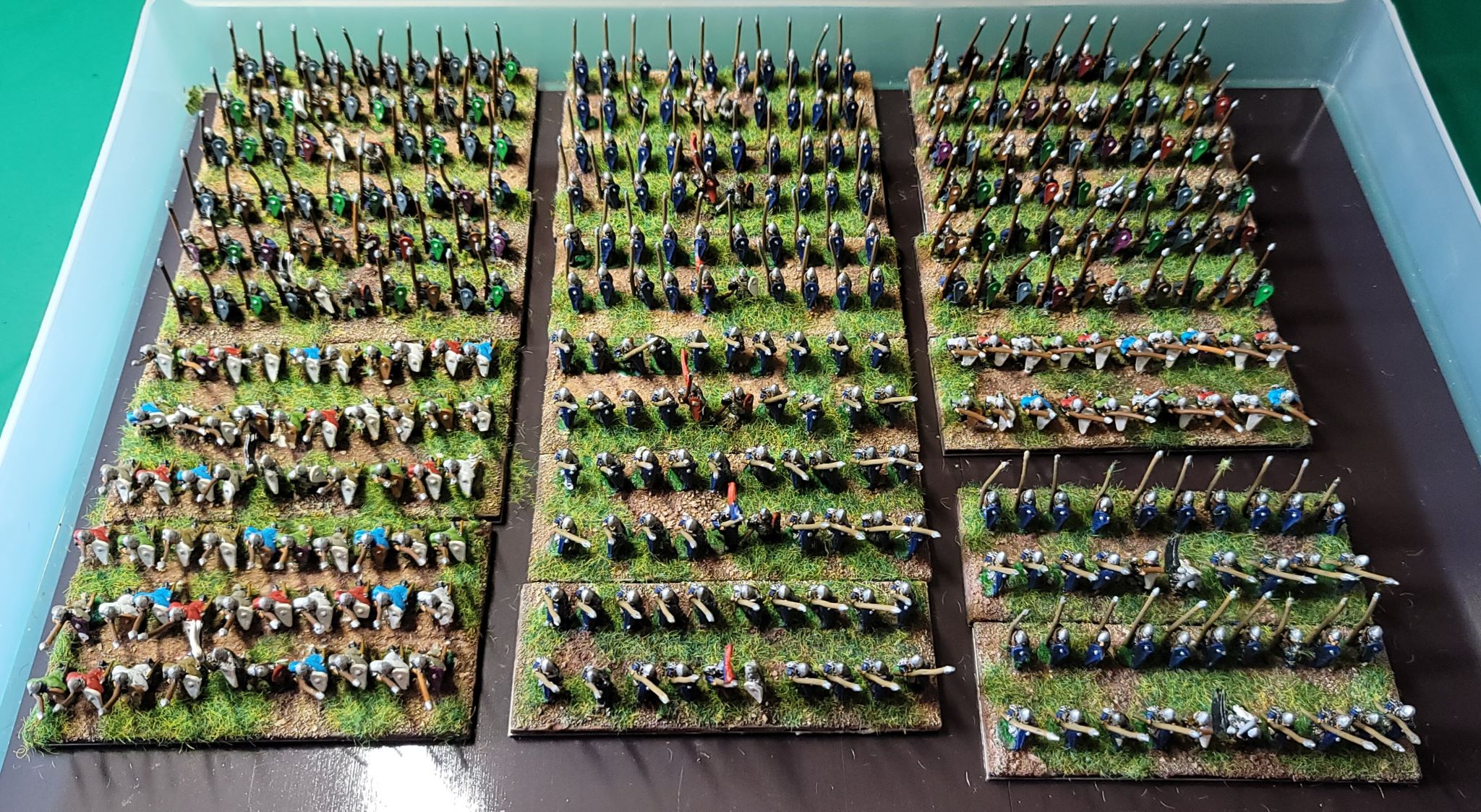
Left to right, front to back: Fyrd; Foot Sergeants; Flemish Spearmen, Norman Militia.

The sand was applied to the Tetrion while it was still wet. The best results are achieved by having the Tetrion very wet. But getting the filler between multibased ready-painted figures was awkward.

The bases were initially flood painted with a very dilute wash of household emulsion. The sand soaks it up. They were then dry-brushed with Zamesi Desert and Ushabti Bone.

The static grass was applied with an electric applicator. I'm not entirely convinced this made much difference but it didn't do any harm.

Left: Feudal levies. Front: Crossbows. Back: Bows.

I learnt two lessons from this project:

  1. Basing the figures before painting as I did for my 10mm ACW and 6mm TYW armies is a much better approach for multibased figures. In this instance most of the figures were already painted so I wasn't working from scratch. I'm not sure, however, whether I would pre-base 15m or 28mm figures, but I would certainly think about it.
  2. Dry-brushing the bases in just two colours was adequate.

The overall approach was based on expending the minimum effort and time, and to rely on the new bases for aesthetic effect. In that it was a resounding success.

Sunday, 1 December 2019

Lion Rampant: Bloodbath scenario

Simon's Burgundians far side. My Swiss near side.
This was my second game of Lion Rampant, fought back in January, and was a first outing for my Late Medievals. Simon commanded the Burgundians whilst I had the Swiss. The armies were 24 points each.

Burgundians
2 Pike (Foot Serjeants) @ 4
2 Veteran (Expert) Archers @ 6
1 Crossbows @ 4

Swiss halberdiers on the right are reluctant to advance.
Swiss   
1 Pike (Expert Foot Serjeants) @ 6
2 Halberds (Fierce Foot) @ 4
1 Handguns (Bidowers) @ 2
1 Crossbows (Bidowers) @ 2
1 Foot Men-at-Arms @ 6

My Bidowers (left) close but the main attack lags behind.
I had designed the Burgundians as a steady warband with good missile-power and the Swiss as do-or-die desperados.

My plan as the Swiss was to conduct a delaying action on my left with my Bidowers while attacking on my right with the halberdiers and, more cautiously, in the centre with my pike and Men-at-Arms.

Casualties mount on my left-hand halberd unit.
My Fierce troops certainly had Simon worried, a threat I jokingly exaggerated! In the event they were slow to move off and were then very badly shot up. One of the units never recovered. The other was delayed. This was basically the end of Plan A.

My best and only remaining chance then lay in the centre - Plan B. I wiped out the enemy Crossbows with my Men-at-Arms but the opposing pike went into schiltron. This made the pike-to-pike contest more-or-less even when it would otherwise have been in my favour.

My main attack is shot to pieces.
I was successful in using the Bidowers to tie up the units on Simon’s right, but the only point of that was to win elsewhere which I obviously didn’t.

Full marks to Simon for his steady defence. High quality Archers certainly need to be treated with respect.

Some success for the Swiss but a rather sorry end.

Tuesday, 5 November 2019

My introduction to Lion Rampant

The English defending their hearths and homes.
I played this first game of Lion Rampant back in May 2018. This report has been kicking around for some time. The game was set in the Dark Ages but we used just the ordinary Lion Rampant rules rather than the Landwasters and Raven Feeders extension. We didn't use Leader Traits or Boasts.

The English viewed from their left flank. What a nice little village!
I set up a trial scenario based on forcing a river crossing. The Attacker's objective was to get across a ford and contact a settlement. The Defender's objective was to prevent that, but the game was basically about crossing the ford (and trying out the rules).

The Viking marauders.
The game featured my old 25mm Viking army which I'd split into two armies and rebased on coins. My opponent, Bernard, had a generous 34 points of Vikings while I had 24 points of Anglo-Danes. They would never have called themselves that, so let's just refer to them as the English.

Squaring up at the ford.
Vikings
2 Huscarls (Men-at-Arms)* @ 12
1 Hirdman (Serjeants, Expert) @ 6
2 Bondi (Yeomen, Mixed Weapons) @ 10
1 Berserkir (Fierce Foot) @ 4
1 Scouts (Bidowers) @ 2

The English unit at the ford is well-supported.
English
2 Huscarls (Men-at-Arms)* @ 12
1 Select Fyrd (Serjeants) @ 4
1 General Fyrd (Yeomen, Javelins) @ 4
2 Skirmishers (Bidowers) @ 4

Face-to-face.
We played lengthwise on a 6' x 4' area. The river was impassable apart from the ford which was difficult ground. The felt templates represented copses. I didn't have any large trees at that time. The wattle fencing was a linear obstacle, but the Vikings never got that far.

The Berserkir, already weakened, finally make their move.
The Vikings enjoyed a prompt start. Bernard held the Berserkir back to avoid any wild charges but they eventually emerged as his unit of choice to contest the ford, but when they got into position they refused to do so! Evidently too many magic mushrooms. This gave my skirmishers a good opportunity to shoot them down.

The English counter-attack across the river.
We played for about 2 hours before calling time. The Vikings never did get across the ford but had the game continued they probably would have done. As we had not defined a game end point, we agreed to call it a draw.
 
A ford too far exposes the English unit to annihilation.
We found that shooting can be quite decisive. Faced with missile troops, fighting defensively is not really an option. Had the game continued (and if my Retinue had not been so depleted!) I would have been forced onto the offensive.

Friday, 2 March 2018

28mm Plastics for the Swiss-Burgundian Wars

Perry Late Medieval European infantry.
Despite my current aversion to and lack of time for painting, let alone assembly, I've been completely seduced by 28mm hard plastics. Of course, they've been around for some time, but as I hadn't previously had much use for 28mm I never gave them serious consideration.

I did feel plastics were 'insubstantial' but since taking a particular interest in Dan Mersey's rules and scanning eBay for used 28mm recruits, I was struck by the fantastic appearance and quality of these figures.

Besides having better detail and proportions than many metal miniatures, and their potential for variation and customisation, they are also, obviously, lighter to carry and less likely to get damaged in transit or use.

I recently bought some second-hand 28mm Afghans for The Men Who Would Be Kings and it wasn't until I started handling them that I realised that they were a mixture of metal and plastic, so I had inadvertently already bought my first plastics.

However, I'm really interested in using plastics for a new project. There are very few ranges in comparison with metal figures but one area that has taken my fancy and is available from Perry Miniatures is the High Middle Ages which I wanted to do for Lion Rampant. The figures are sold as Wars of the Roses and European Mercenaries. There are currently five boxes as well as a range of metal figures to fill the gaps, e.g. artillery, although that's not particularly appropriate to a skirmish game.

I already had 15mm Wars of the Roses armies which I had no desire to duplicate, but I didn't have anything for the following Swiss-Burgundian Wars. I do in fact already have Swiss in 25mm but they are circa 1525 and based for Impetus.

The big question for me was whether to buy the boxes new or try to pick up figures second-hand. If I bought the boxes I would be able to organise, customise and paint exactly as I wanted. But then I took a reality check, realising that I would probably never have time to finish them.

If buying second-hand, on the other hand, I would have to choose carefully as most second-hand figures would probably have been painted for the Wars of the Roses. This is not an insurmountanble problem as many, but not all, livery colours could be recycled. The Burgundians wore blue and white so any figures with that combination or which could be easily overpainted could go to that side.

Some Swiss cantons also sported blue and white but that would be confusing. Bern was the biggest canton and its colours were red and black. These are strong colours which could, if necessary, be painted on top of other colours. And red and white were both cantonal and the 'national' colours of the Swiss Confederation, I think red, red and white, and red and black should all be fine for the Swiss. It would be more the suggestion of a uniform than an actual uniform, but I think that is quite realistic and what I would have wanted to achieve if I had painted the figures myself.

Anyway, I was very lucky to pick up some useful lots from eBay which I'm currenlty waiting to be delivered. I won't have any pikemen but I will have quite a range of other troop types.

Sunday, 11 February 2018

Repurposing my 25mm Vikings

Back in the days when I played 25mm WRG Ancients it was common to raise a discrete army of your choice and to pit it against the armies of other players. These match-ups were usually unhistorical, and one's opponents were often WRG super armies like Seleucids and triple-armed Late Romans. This left me with a couple of isolated armies which haven't been used for decades.

I offloaded my Later Greek Hoplites years ago and I'm planning to sell my Sassanid Persians, but I thought I'd repurpose the Vikings. Although the army would be relatively small for a game like Impetus, it will comfortably stretch to two skirmish-level warbands.

I had originally thought of using Saga, but I'm now more likely to try Landwasters and Raven Feeders, the official Dark Age variant of Dan Mersey’s Mediaeval rules, Lion Rampant. Some people have criticised Dan’s rules for being too simple, but I’ll live with having fun and finishing a game, or even two, in an evening.

When I first started collecting this army there weren't many multi-pose packs about, so I bought figures from different manufacturers and ranges so that every figure was unique. This mixture will now work to my advantage. The unarmoured infantry are pretty generic anyway, while the more stylistically-specific armored figures should split well enough into typically Anglo-Danish and Viking forces, though I do have some doubts that they would have been very distinguishable by the 11th Century.

The Lion Rampant Mediaeval categories readily translate into Dark Age types. OK, I’m aware of armour development, but this is a game not a scientific simulation, and the important thing is 'relative' difference.

These are the Mediaeval game categories and the Dark Age types I will have:

Foot Men-at-Arms
Anglo-Danish and Viking Huscarls with two-handed axes.

Foot Serjeants
Armoured spearman - Select Fyrd or Viking Hirdmen.

Foot Yeomen
Unarmoured spearman - Great Fyrd, and Viking Bondi who will be additionally armed with mixed weapons (i.e. will include archers).

Fierce Foot
Viking Berserkir and Ulfhedhnar.

Bidowers
Anglo-Danish skirmishers and Viking scouts with various missile weapons.

Next step is to take the figures off the old bases, throw away those afflicted with lead rot and then rebase the survivors on 2p coins. For skirmish games I really don’t like the look of rectangular bases, and I’m not keen on movement trays either. If I’m short of figures I can press some half-painted ones into service as I have plenty of those in the lead mountain. These were on my workbench over twenty years ago, but were packed into a box when I moved  house and have not seen the light of day since. I'll post some pictures when I've reorganised and rebased them.

Friday, 15 January 2016

Impetus: Feudal English vs Feudal Scots

Scots on left from the foreground: knights, peasants,
schiltron, ribaulds (advanced to marsh), Highlanders,
Islanders and the mass of schiltrons and archers. English
on right from foreground: knights, sergeants, knights,
Welsh archers.
Following the Pavia refight, my next Impetus game featured 15 mm Feudal English versus Feudal Scots on a regulation 4' x 3' area. My 15 mm Ancients/Medievals are another group of armies that haven't seen the light of day for at least twenty years.

As all the figures were mine I drew up the army lists for the sake of convenience. Each army was divided into three commands. My opponent, Ian, who ended up commanding the Scots, had warned me to balance the commands. I ignored this advice but it caught up with me during the game. Each army was organised in three commands with all generals attached.