Showing posts with label Ancients. Show all posts

Sunday, 23 October 2022

27 years later: unpacking my 25mm Sassanid Persians

Having only ever played To the Strongest! in our two-strong, self-taught, local bubble, I thought it would be instructive to take part in a TtS! tournament at some point. While TtS! is played in various scales, tournaments are all 28mm. I therefore decided to dig out my slightly height-challenged 25mm Sassanids to see if they would stretch to a 135-point TtS! competition army.

We moved house just over 27 years ago. The figures were packed in polystyrene chippings and haven’t seen the light of day till now. Unlike my 25mm Vikings unpacked a few years ago, there were no signs of lead rot.

The figures, which I painted myself, are Lamming Miniatures which have now been brought back into production and are available from https://www.lammingminiatures.com/. The figures have a distinctive style - I would say charm - and are very robust but they don’t have the multiplicity of variations you see in modern ranges.

The spears are made from piano wire - not as fancy as the wire spears with shaped spearheads you can buy now - but correspondingly less likely to impale players. 

It looks like they would do but I would probably rebase them. Unfortunately they are lacking historical opponents which is something I like to have these days.


Elephants, Cataphracts and Cavalry

Horse Archers, Slingers, Bowmen, and Javelinmen
 
Spearmen


Tuesday, 15 February 2022

To the Strongest! - first game


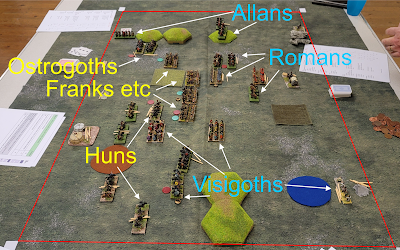
I put on and umpired a game of To the Strongest! at my local wargames club. Bernard commanded the Huns and allies (left) while Ian had the Romans and allies (right).

The Allans flanked the Ostrogoths (top) and the Visigoths pushed back the Huns (bottom). In the centre the Romans and their Frankish and other Germanic opponents traded blows fairly evenly.

I had already gone through some moves in a solo game a few days before, so I had a reasonable grasp of how the game is played. I don't think we forgot anything or made any mistakes. The players were quick to pick up the flow.

Most importantly my wargaming comrades enjoyed playing and have a positive view of the game, endorsing my own optimism and paving the way to play the game in the future.

The photo above shows the situation at the end of five game turns. The figures are all 15mm from my collection. The Allans are proxies.

The game didn't reach a decision but the Huns were under pressure. 

I'll be sorting out some Feudal era armies for the next game and we'll play with slightly fewer units and just two commands a side while we're becoming more familiar with the rules.

Wednesday, 2 February 2022

Rebasing without tears - DBx basing, steel sabots and magnetic storage

15mm Frankish Warriors in three
ranks, on and off steel sabots.

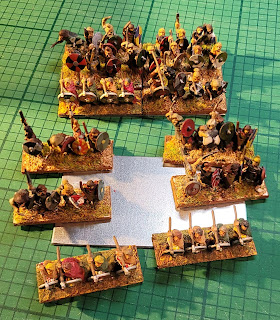
As a grid game To the Strongest! doesn’t stipulate any particular basing requirements, and as my 15mm Ancients and Medievals are already based for DBx, it's just a question of combining them into larger units. The figures all have magnetic sheet underneath their bases so the obvious solution was to put the DBx elements onto steel sabots. 

Retaining the original bases means they will also remain usable for other rules. I had already gone down this route to some extent in order to play Impetus so I just needed to get more steel bases of various depths.

After some thought and experiment I eventually decided on one sabot per unit and I am now absolutely convinced this was the best choice. If I ever play some other game requiring different basing, I'll just get more sabots of appropriate size.

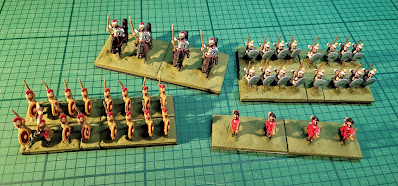
15mm Late Roman cavalry, Auxilia, Legionaries and lights.

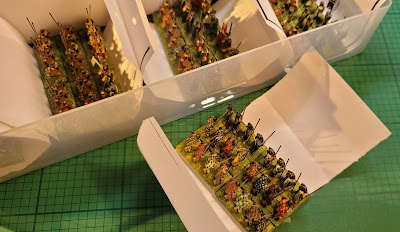
As I usually have to transport my armies on foot, I'm very keen on secure storage, so the sabots (with the figures on them) will in turn be placed into boxes lined with magnetic sheet. I've yet to find out just how well the figures stay on the sabots, but the sabots adhere strongly to the boxes. 

In fact, the attraction is so strong that I've had to put paper ‘ribbons’ under the bases so I can pull the sabots out without scattering the figures. Maybe there’s a slicker solution but this does seem to work.

15mm Feudal Scots with strips of paper to lift them out.
These figures were actually painted by me. The figures in the other photos weren't.

As mentioned above, I used to put magnetic sheet under the bases but it's much less trouble to snip off bits of magnetic tape. The tape is just a little narrower than the DBx base depths, so 12.5 mm for 15mm, 15mm for 20mm and 25mm for 30mm.

I currently get MDF bases and steel sabots from Products for Wargamers, magnetic tape from Magnetic Displays, and magnetic sheet from TinyTinTroops.

Monday, 6 December 2021

To the Strongest!

Although gaming massed battles with Ancients was once my main wargaming activity, I've done very little of that in recent years.

I enjoy DBA but my circle of players haven't moved on to Third Edition and I don't want to take a backward step. I would never go back to DBM or its derivatives - too much unnecessary detail. I like Impetus basing but didn't take so much to the rules, though I haven‘t yet tried the current edition. ADLG was judged a good game but too demanding for a club evening. I’ve also played and enjoyed Sword and Spear but for one reason or another none of them stuck.

And then, by chance, I recently noticed To the Strongest! by Simon Miller of The BigRedBatCave blog, a set of rules that has been out for some time but which I had previously managed to overlook despite being on Simon’s mailing list at one point. I’ve now bought the rules and army lists and a new gridded mat, gathered some playing aids and have begun to reorganise and even supplement my collection of 15mm Ancients/Medievals.

I haven't yet played this game so I won't go into too much detail but they look very promising. Activation is at the game’s heart, providing the friction that reminds players they are mortal, and this is achieved not with dice but playing cards. Friction is essential in game design but too frustrating for some gamers! In TtS! activation failures are ameliorated by the ability of Generals to replay an activation card once per turn and there is also an amendment introducing group moves which reduces the chance of some units being inappropriately left behind. Players can also intervene by using 'Heroes' to replay missed 'to-hit' cards.

The other big feature is that like Commands and Colors, this is an area movement game played on a 12 x 8 grid. Grids are not to everyone’s taste, but they allow players to concentrate on generalship rather than geometry, eliminate measuring disputes and speed up play. If figures and scenery are good and the grid not too obtrusive, it will look and feel like a miniatures game, not a boardgame.

As a grid game TtS! doesn't demand any particular basing but I believe it's prudent to retain, more-or-less, DBX standards, albeit with the DBX bases combined onto larger sabot bases. As my 15mm Ancients/Medievals already have magnetic bases I can put them on steel sabots which means they will be detachable and still usable for Impetus, Dux Bellorum, ADLG, DBA or anything else my wargaming comrades agree to play.

I decided on 80mm frontages and 100mm (4”) boxes which means that units will be two DBX elements wide and the 4’ x 2’8” playing area will conveniently fit my modest dining-room table.

At the moment I am learning the rules but I hope to try them out in the near future.

Wednesday, 16 October 2019

Two games of Commands & Colors Ancients

Commands & Colors: Ancients is probably the best of the C&C games, a series that for me sits somewhere between a boardgame and a gridded miniatures game depending on what you use to play it.

C&C Ancients and its extension sets offer a huge range of historical scenarios which you can set up in minutes.

Ian and I fought two games. In the first, Cynoscephale 197 BC, I commanded the Macedonians against Ian's Romans and won.

In the second, Battle of the Sabis River 57 BC, I had Julius Caesar's Romans against Ian's Belgae and lost. It was a close-run game.

Ian has a lot more experience of board wargames so he gives me  lot of advice. This means he's often playing against himself. So he always deserves the credit, whoever wins!

Like every game, C&C has its quirks and you need to 'play the game' to win. There are no objectives other than the total destruction of a given number of enemy units, and you constantly need to keep that priority in mind.

The other priority is to use your opportunities (the cards) as efficiently as possible, which means that you sometimes have to compromise about where to attack.

Finally, I was reminded of the importance of supporting units with two other units, something I'd completely forgotten about, and, in fact, don't even remember!

Anyway, this has fired up my interest in C&C and I've just ordered a copy of the new Commands & Colours: Medieval which covers the Early Medieval period - Huns, Byzantines and Sassanids.
Cynoscephale. My light troops commence
the game with good control of the hills.
Ian makes a strong atack on my left. I was
tempted to counter this but better opportunities
presented themselves elsewhere.
My left holds while my centre advances
successfully.
And it's curtains for the Romans. In the real
battle the Macedonians were heavily defeated.
Sabis River. I seem to have taken only
one shot at the end. I was successful on my
right but badly mauled on my left. Caesar
survived but the 10th Legion was wiped
out. Ian pipped me at the post on the
last victory point. In the real battle, Caesar crushed the Belgic tribes.


Friday, 23 November 2018

L'Art de la Guerre

In my first wargaming career as an adult - from the late 70s to the early 90s - WRG Ancients was the game I played more than any other, and I progressed through various rule editions, scales and rebasing experiences. When I returned to wargaming sometime after 2000 I couldn't go back to the mental contortions of Barkerese and took up other periods and games like Crossfire.

Over the intervening years I played a few games of Ancients with various different rule sets including DBA, which I did enjoy,  but I didn’t commit to any of them. Just recently a couple of friends at my wargames club, Bernard and Chris, organised a game of L'Art de la Guerre in which two other players - James and myself - enjoyed minor roles. None of us had played the game before, and my only introduction had been looking at the rules for an hour earlier in the day.

The game featured Sassanids versus Byzantines. In order to speed things up a small amount of scenery was arbitrarily placed on the table, but otherwise I think we followed the proper procedures. The game is said to be playable to a conclusion in two-and-a-half hours. We managed four moves each which for a first game seemed reasonable.

It's early days but all four players were positive about the experience. The photos show the course of the game as far as it went.

View of the Sassanid army from the Sassanid side.

The Sassanid and Byzantine armies from the Byzantine side.

The armies skirmish on the left and in the centre.

My command gets stuck in with mixed results.


The Byzantine centre weakens, but my light cavalry catch the Sassanid left flank.


The left flank conflict is as yet indecisive. The Byzantine centre is partly eliminated. The Sassanid left flank is under pressure. The Sassanid centre is strong and unopposed but can it be brought to bear on the flanks?


ADLG is now strongly established so I'll just comment on a few aspects that struck me. The standard game is fought with very convenient sized armies in a reasonably convenient area. The army lists are clear and strike a good balance between simplicity and complexity. They are also realistic and avoid the obscure gimmicks that are a feature if other rule sets, and which competitive players latch onto if it brings them game advantages.

While DBA is a game of sudden outcomes in which units die or survive unscathed, ADLG units suffer cumulative damage before destruction. This introduces a significant element of attrition, and seems to invite the need for intervention by reserves. Once the troops are locked in combat there is otherwise not a great deal of use for Pips.

Of the Ancient games I've played in recent years - DBA, Impetus and Sword and Spear, ADLG seems to be the most promising for my tastes, so I've set about reorganising my 15mm Ancient and Medieval armies and will rebase and supplement them where necessary. It will be good to get these armies out of their long retirement.

Tuesday, 24 January 2017

A strategy for wargaming

Owing to competition from another diversion I'm likely to have even less time this year for wargaming, so I need to optimise use of time I do have. In the past I've tended to flit from one game to another, which makes absorbing rules very difficult. A considerable proportion of gaming time is spent looking things up. Then you don't return to that game for weeks or months and the whole process starts all over again.

This year I'm aiming to become a serial gamer, playing the same games several times before moving on to another one. My current obsession is Command & Colors: Ancients. I've so far played two games and the strategy is certainly working.

Command & Colors: Ancients - Zama. At this point the Carthaginians (near side) were trailing badly.

The first game was the Battle of Akragas 406 BC. I got the Syracusans while my club comrade Chris took the Carthaginians. C&C:A scenarios are not necessarily balanced so the aim is to improve on the historical outcome. The Syracusans should have won but I lost. My ultimate defeat was entirely my own fault when I failed to retire an exposed general.

Chris had not played the game before and I had played it very little some time ago, so a great deal of the game was spent reading rather than playing and I'm not entirely certain we got everything completely right.

The second game was the Battle of Zama 202 BC.  This time I did a little preparation. In particular I studied the elephant rules and planned to counter the beasts with ranged fire from light infantry. In the event I got the Carthaginians (the historical losers) while Chris commanded the Romans!

Having also noted the effect of elephants on cavalry (to be expected), I began to move the elephants to the flanks where Chris had a predominance in cavalry. This was not a bad idea but Chris's light infantry soon closed in on them and took them out in close combat.

The problem with the Carthaginians in this game is that once the elephants are gone you are outnumbered in both cavalry and infantry. Despite this I managed to achieve some good local successes and the balance of Victory Banners (which you win for destroying units and sometimes for occupying objectives) was running at 7:7. It was a very close-run thing but Chris eventually got the eighth and final kill.

What I like about C&C:A is that it allows you to fight historical battles with a minimum of complication. By only the second game of this series, I had absorbed most of the rules and factors, and much less time was spent looking things up.

Saturday, 21 November 2015

Sword & Spear

I recently played and enjoyed my first two games of the Sword & Spear ancient rules. The armies were Late Roman vs Germanic Tribes. I lost with both armies, but the second game in which I commanded the Romans was quite close run.

S&S is easy to pick up and remember with virtually no need to refer back to the rules. This was particularly assisted by the Charlie Foxtrot Models customised measurement stick marked with specific movements and ranges, an idea I will be stealing for other games. After just one game I was able to drive a lot of the next one.

Wednesday, 11 February 2015

My introduction to Command & Colours

The first scenario from Command & Colours Napoleonics
Despite my enthusiasm for wargaming with hexes and blocks, I played my first couple of games of Command & Colours Ancients only last year, although I had previously played a couple of games of BattleCry, the ACW variant of the system.

As the game system has been out for some time and most readers are probably more familiar with it than I am, I won't attempt a comprehensive review, but I would like to share a few points in its favour for the benefit of anyone who hasn't played it. One's first impressions of a game are always improved by winning. I did win both games, though my opponent inevitably attributed this to lucky dice throws rather than tactical genius!